
Somewhere in your city, there are probably sensors doing their jobs right now. Parking spaces signalling whether they are free. Sensors log river levels every few minutes. Cold chain containers are pinging their temperature as they move through a warehouse.
None of them has a SIM card. None are connected to WiFi. They are using LoRaWAN, and most people have never heard of it.
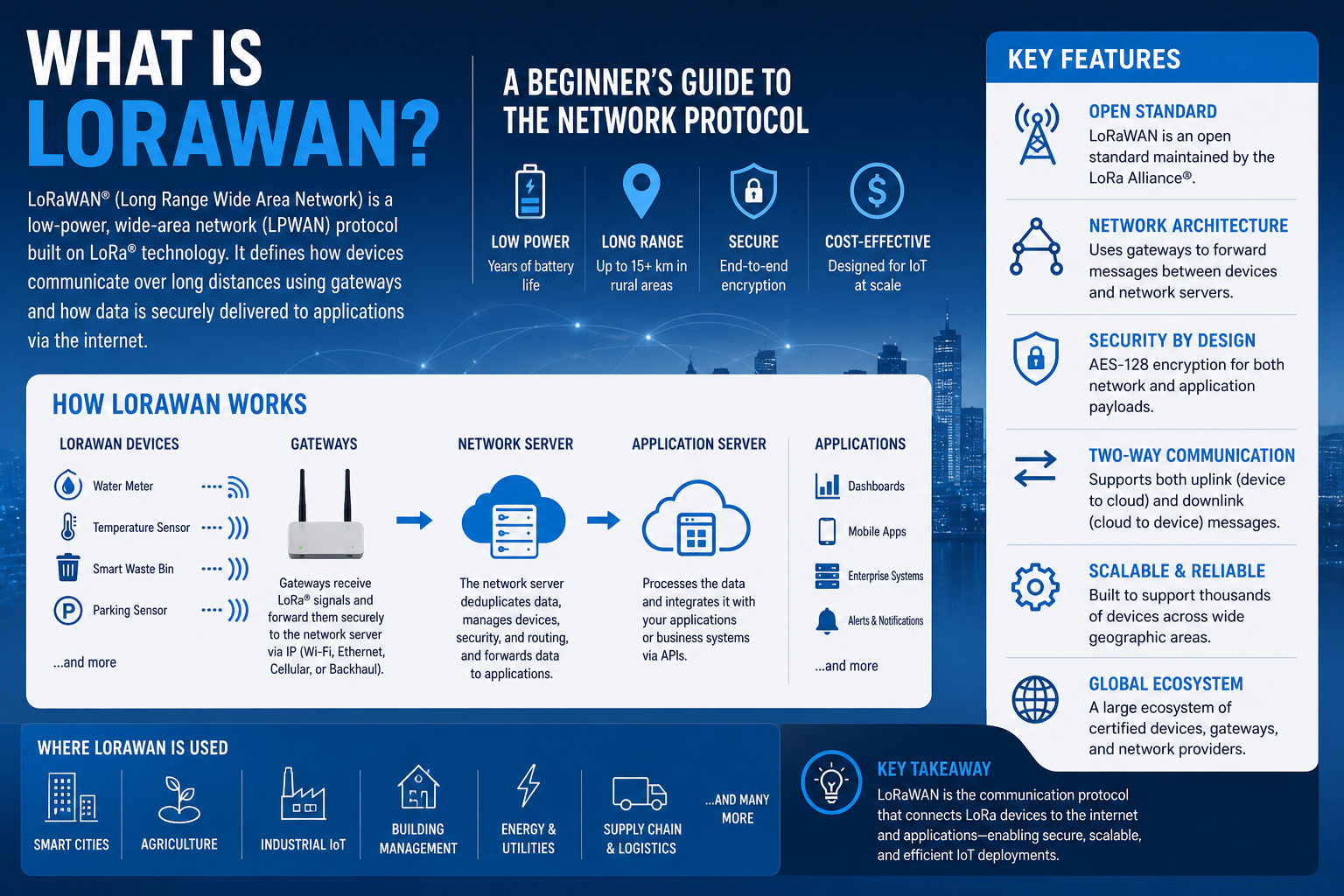
LoRaWAN is a low-power wide-area network protocol designed to connect IoT devices over long distances with minimal power use. It runs on LoRa radio hardware but adds everything the radio layer deliberately leaves out: addressing, routing, security, and the infrastructure to get data from a device in a field all the way to a cloud platform.
If you have read about LoRa modulation or the difference between LoRa and LoRaWAN, this guide goes a level deeper. It covers how the protocol actually works, who manages it, where you can connect to it, and what it is genuinely good for.
Who builds and maintains LoRaWAN
LoRaWAN is an open specification managed by the LoRa Alliance, an industry group with hundreds of member companies. That matters because it means the protocol is not locked to a single manufacturer or cloud provider. Any company can build a LoRaWAN-compatible device, gateway, or network server, and they will all interoperate.
Semtech makes the LoRa radio chips that power the physical layer, but the network protocol on top is entirely open. The Things Network, Helium, AWS IoT Core, and dozens of regional operators all run LoRaWAN-compatible infrastructure.
The three layers of a LoRaWAN deployment
LoRaWAN follows a star-of-stars architecture. To understand it, think of three distinct components working together.
End devices are your sensors, trackers, or actuators. They are small, battery-powered, and they broadcast their data using LoRa radio. A soil moisture sensor, a GPS tracker on a pallet, a temperature logger in a fridge: all of these are end devices. They transmit their data and then go back to sleep. They do not route traffic, and most of the time, they do not receive anything.
Gateways listen for those transmissions and forward them on. A single gateway can receive packets from many end devices simultaneously, over distances ranging from several kilometres in a city to tens of kilometres in open countryside. The gateway itself does not process the data. It forwards every packet it hears to the network server over an internet connection, typically via Ethernet or a mobile data connection.
The network server is where the intelligence lives. It handles deduplication (because multiple gateways often hear the same packet), manages the security keys for every registered device, and routes decrypted data to your application. Self-hosted options like ChirpStack let you run your own. Public platforms like The Things Network provide it as a service.
The end device never touches the internet directly. It just broadcasts, and the infrastructure does the rest.
How security works
LoRaWAN uses AES-128 encryption at two separate layers. One protects the session between the device and the network server. The other protects the payload between the device and your application. Even the network operator cannot read the application payload because that key is held only by the device and your application server.
Joining the network works through a process called OTAA, or Over-The-Air Activation. The device broadcasts a join request containing its credentials. The network server verifies them, and if everything checks out, it sends back the session keys the device needs to encrypt its future transmissions. Keys are rotated each time a device joins, which is the recommended approach for production deployments.
There is an older method called ABP, Activation By Personalisation, where you hardcode the session keys directly into the device. It is simpler to set up, but it has security implications: if the keys are compromised, there is no rotation mechanism, and devices can end up with the wrong frame counter after a reset. OTAA is the better choice for anything serious.
Connecting to a LoRaWAN network
You do not necessarily need to build any infrastructure yourself. Public LoRaWAN networks already cover significant portions of many cities.
The Things Network is the largest community-operated LoRaWAN network. It is free to use for fair-use data volumes, and its coverage map shows community gateways in cities across Europe, North America, Asia, and beyond. If you are in a reasonably populated area, there may already be a gateway within range of your front door.
Helium is another public network, incentivised by rewards for gateway operators. Coverage is patchy compared to TTN in some regions, denser in others. Worth checking the coverage map before relying on it for a project.
For anything where reliability matters, a private LoRaWAN deployment is the better choice. You install one or more gateways, run your own network server (ChirpStack is the go-to open-source option), and have complete control over your data, device registration, and coverage. It takes more effort to set up, but it is the standard approach for commercial IoT deployments.
Device classes: what they actually mean
LoRaWAN defines three device classes, which control when and how a device can receive messages from the network.
Class A is the default and by far the most common. A device transmits whenever it has data to send, then opens two short receive windows immediately afterwards. Outside those windows, it does not listen. This is the most power-efficient option, which is why most battery-powered sensors are Class A.
Class B adds scheduled receive windows, synchronised to a regular beacon broadcast by the gateway. This lets the network send downlink messages at predictable times rather than only after an uplink. It uses more power, but it makes actuators and controlled devices more practical.
Class C devices listen almost continuously. If you need near-instant downlink delivery and power is not a constraint, such as a mains-powered relay or a smart streetlight, Class C is the right fit.
What LoRaWAN is genuinely good for
LoRaWAN is the right choice when you have many devices spread across a large area, need them to run for years on a battery, and have low data-rate requirements. Temperature readings every 15 minutes, a GPS position once an hour, a water meter reading once a day: that is the sweet spot.
Real-world deployments include smart agriculture (soil sensors, irrigation monitoring), smart cities (parking management, flood sensors), industrial asset tracking, and utilities metering. Any scenario where running a cable or a SIM card to every device is impractical is a scenario where LoRaWAN earns its place.
It does have real limits. Data rates top out at around 50 kbps under ideal conditions, and typical payloads are tens to a few hundred bytes per transmission. In the EU, duty cycle restrictions limit how often devices can transmit, typically to around 1% of the time in most sub-bands. You will not be streaming data or sending updates every few seconds over LoRaWAN.
How LoRaWAN compares to the alternatives
The main competitors for low-power wide-area connectivity are NB-IoT and LTE-M, both of which run on existing cellular infrastructure. They offer higher data rates and better downlink support, but they require a SIM card and a cellular subscription, and they depend on mobile operator coverage. In rural areas or deep indoor environments where the cellular signal is weak, LoRaWAN often wins in terms of range and reliability.
For off-grid peer-to-peer use without any infrastructure, Meshtastic takes the LoRa radio layer in a completely different direction. No gateways, no network server, no registration process. It is built for direct communication between people rather than for sensor data collection, and it requires no internet connection.
Getting started
The lowest-friction entry point is a development board with a built-in LoRa radio, such as a TTGO LoRa32 or an Arduino MKR WAN 1310, paired with a free account on The Things Network. You register your device, flash the appropriate firmware or write a simple sketch, and within a few minutes, you can watch your first packet arrive on the TTN console from across town.
The stack is approachable, the community is active, and the hardware is inexpensive. For anyone building IoT projects that need to cover long distances without relying on mobile data or cables, LoRaWAN is remarkably capable, given how little power it consumes. The city full of invisible sensors is doing something genuinely clever, and you can build your own piece of it for the cost of a pizza.