
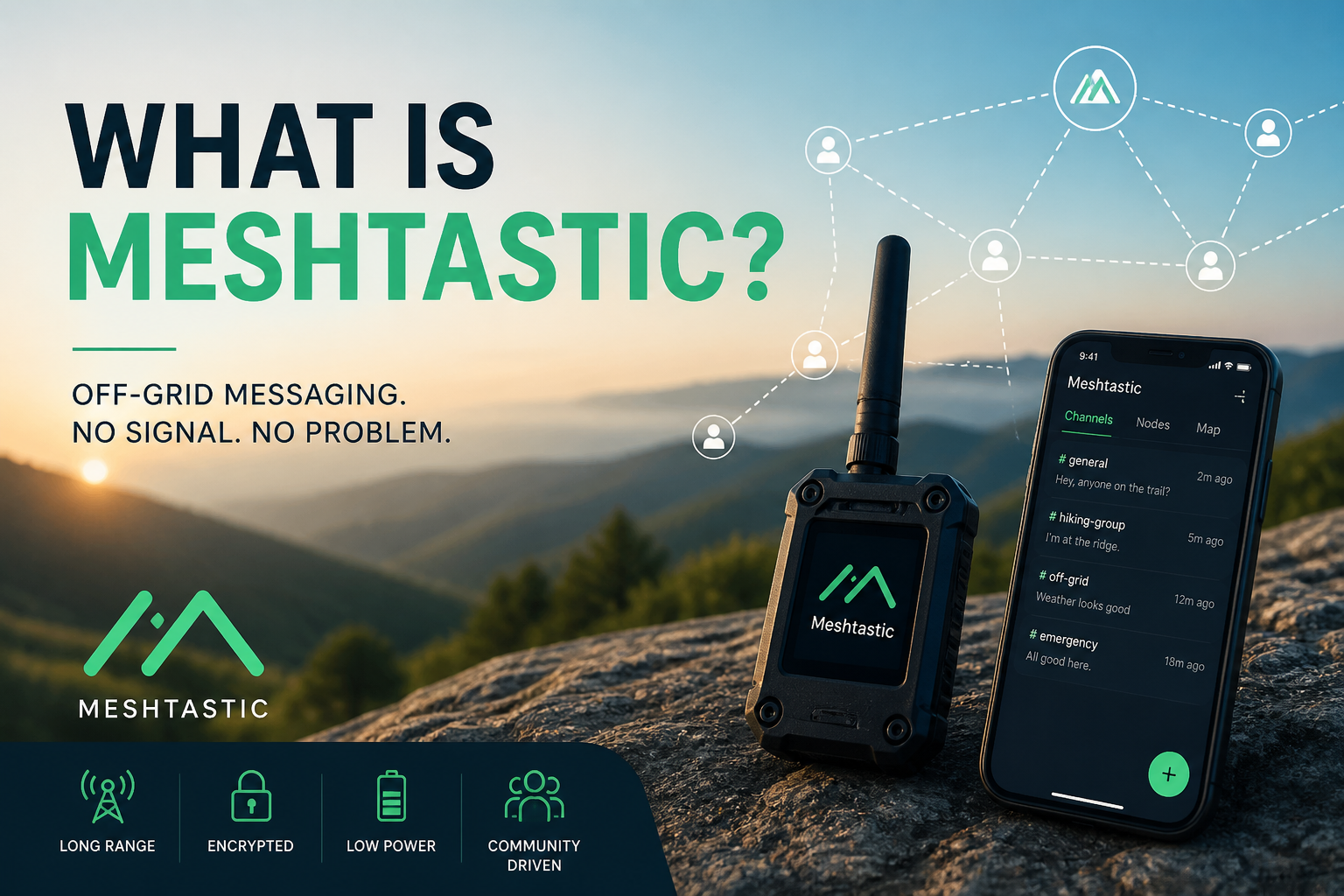
Imagine this.
You’re out somewhere remote. Maybe it’s a hike, maybe a festival, maybe just a part of town where the signal always seems to disappear at the worst possible moment. You pull out your phone, try to send a message, and nothing gets through: no bars, no data, no way through.
Now imagine your message still sends anyway.
Not through a tower. Not through Wi-Fi. Not through the internet at all. It just quietly hops from one small radio device to another until it reaches the person you’re trying to reach.
That’s Meshtastic.
And once it clicks, it feels a bit like discovering the internet all over again, just in a much smaller, scrappier, more independent form.
So, what actually is Meshtastic?
At its core, Meshtastic is a way to send messages without relying on any traditional network.
No mobile carrier.
No SIM card.
No router.
No infrastructure.
Instead, it uses small, low-cost radio devices that communicate directly with each other using a technology called LoRa, which stands for Long Range radio. These devices form a network by simply existing near each other. Each one helps pass messages along, a bit like people relaying a note across a room.
You type a message on your phone, hit send, and your nearby device broadcasts it out into the air. Any other Meshtastic devices in range pick it up. If the message is not for them, they pass it on. Then the next device does the same. Eventually, it lands exactly where it needs to go.
No central system. No single point of failure. Just a chain of devices cooperating.
It’s simple, but also brilliant.
Why do people get hooked on it?
There’s something quite satisfying about Meshtastic because it flips a big assumption on its head.
We’re used to thinking that communication requires infrastructure. Towers, cables, servers, data centres. Meshtastic proves that, for basic messaging, it really doesn’t.
People get into it for different reasons.
Some want a reliable way to stay in touch when they’re outdoors. Others are thinking about emergencies where networks go down. Some are deep into the tech side and enjoy building their own nodes, tweaking antennas, and pushing range as far as possible.
And then there’s a growing group who like the idea of a community-built network. Something independent. Something that works because people choose to keep it running.
That part is important. Meshtastic gets more useful the more people use it.
What it feels like to use
In practice, it’s surprisingly normal.
You install an app on your phone, pair it with a small device over Bluetooth, and start sending messages. The phone becomes your interface. The little radio device does the actual work.
Messages are short. Think quick updates rather than long conversations. You might share your location, check in with someone nearby, or send a quick “I’m over here” when meeting up.
There’s sometimes a slight delay, especially if the message is hopping across multiple devices. But that delay is part of the magic. You know it’s travelling, finding its way, moving across a network that doesn’t exist in any traditional sense.
It’s not trying to compete with WhatsApp or iMessage. It’s doing something completely different.
The quiet trade-offs
Meshtastic works because it makes some very deliberate compromises.
It does not try to send large amounts of data. There are no photos, no videos, no endless scrolling feeds. Just simple messages and small bits of information. That simplicity is exactly what allows it to reach so far and run on so little power.
Range can be impressive, especially in open areas. Miles, not metres. But it is still radio, so buildings, hills, and trees all play a role. Where you place your device matters more than you might expect.
And then there’s the human factor. If there are no other devices around, there is no network to hop across. In that case, you are effectively talking to yourself. But as more people join in, the network comes alive.
That’s when it gets interesting.
The bigger picture
What makes Meshtastic more than just a niche tool is what it represents.
It shows that communication does not always need to be centralised. It does not always need to be owned, managed, or billed monthly. It can be local. It can be cooperative. It can be built from the ground up by the people using it.
For anyone in IoT or working with LoRa, it also opens up a different way of thinking. Instead of designing around gateways and infrastructure, you start thinking in terms of devices that collaborate directly. Each one is small, but together they form something much larger.
It’s not a replacement for the internet. It’s not trying to be.
It’s more like a parallel layer. A fallback. A playground. A tool that does one job very well, especially when everything else fails.
So, what is Meshtastic?
It’s a mesh network you can carry in your pocket.
It’s a way to send messages when nothing else works.
It’s a community-built communication layer that grows one node at a time.
And for many people, it starts as a curiosity and quickly turns into a bit of an obsession.
Because once you see your first message travel across thin air, without touching the internet at all, it’s hard not to start wondering just how far you can push it.