
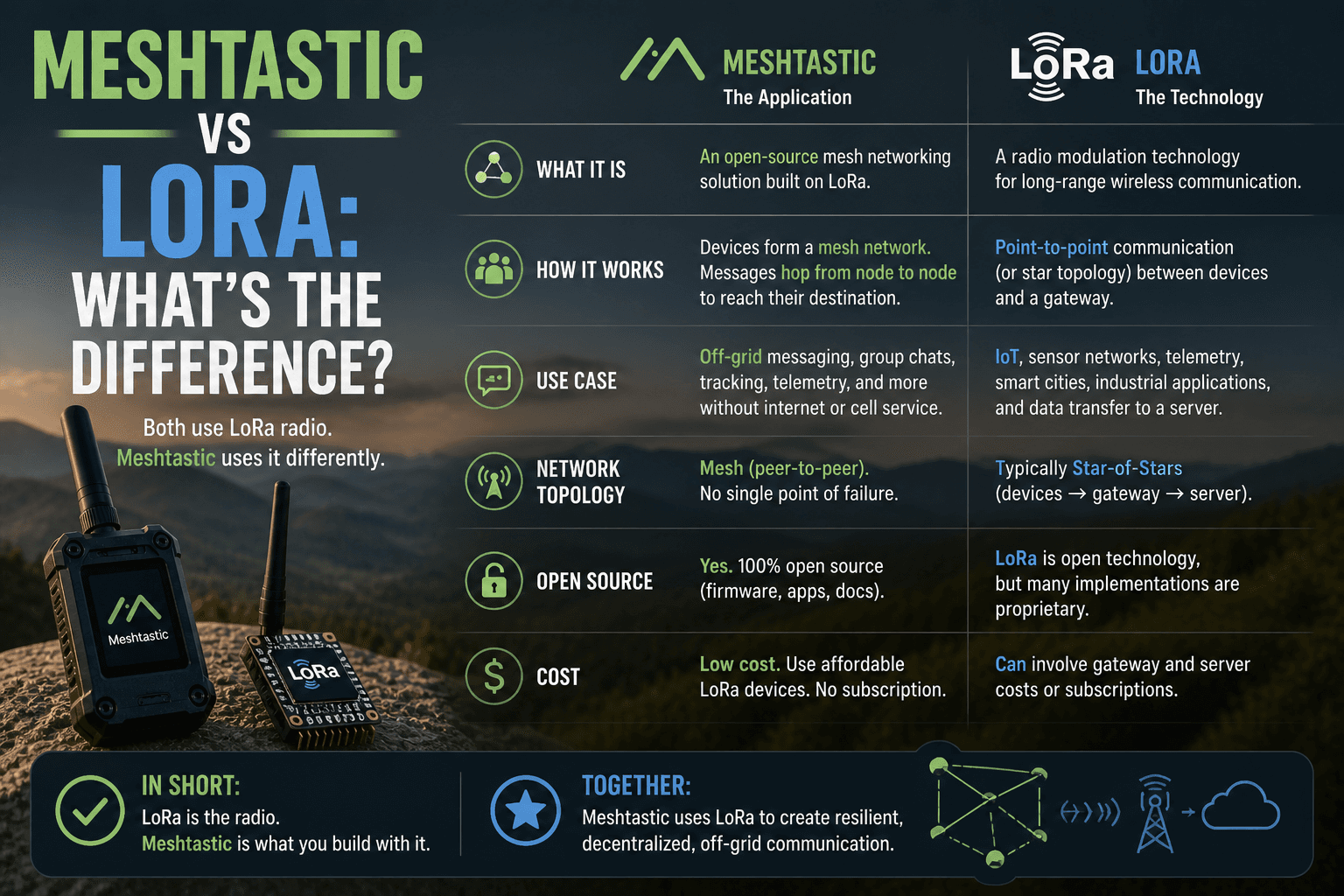
If you spend any time reading about Meshtastic, you will quickly encounter the word LoRa. The two names appear together constantly, and it can be genuinely confusing whether they refer to the same thing, two competing things, or something else entirely.
The short version: LoRa is the radio technology. Meshtastic is software that runs on hardware using that technology. They are not alternatives. One enables the other. But the distinction matters, because it shapes how you think about what Meshtastic can and cannot do.
What LoRa actually is
LoRa stands for Long Range. It is a radio modulation technique developed by Semtech, a semiconductor company, and it describes a specific way of encoding data onto a radio signal. The key property is that it can transmit over very long distances at very low power, by accepting an extremely slow data rate as the trade-off.
LoRa itself is just a physical layer technology. It defines how bits get turned into radio waves. It says nothing about packet formats, addressing, routing, encryption, or any of the higher-level concerns that turn a raw radio signal into a useful communication system.
Many different systems use LoRa as their radio foundation. The most widely deployed is LoRaWAN, a network protocol for IoT sensors that connects devices to internet gateways through a centralised network architecture. Meshtastic is another, taking a completely different architectural approach.
What Meshtastic is
Meshtastic is open-source firmware and a set of companion apps that turn LoRa hardware into a decentralised mesh communication network. It defines how devices find each other, how messages get addressed and routed through the mesh, how GPS positions get shared, and how the whole thing stays encrypted.
Without Meshtastic (or similar software), a LoRa device is just a radio chip that can transmit and receive data. It has no idea what to do with that data or how to build a network. Meshtastic provides all of that logic.
The hardware that Meshtastic runs on typically costs 20 to 40 pounds. That hardware contains a LoRa radio chip alongside a microcontroller. Meshtastic runs on the microcontroller and uses the LoRa chip to communicate.
The key differences in practice
Comparing LoRa and Meshtastic is a bit like comparing Ethernet and email. One is the physical transport layer. The other is an application that uses that transport. They operate at completely different levels.
That said, there are some practical differences worth understanding if you are choosing between Meshtastic and other LoRa-based systems:
Architecture: LoRaWAN, the dominant LoRa network standard, uses a star topology. Devices talk to fixed gateways which relay data to a cloud server. Meshtastic uses a peer-to-peer mesh. There are no gateways, no servers, no cloud infrastructure required.
Range vs coverage: A single LoRaWAN gateway covers a large area, but every device must be within range of that gateway. Meshtastic nodes relay messages for each other, so coverage extends as the network grows regardless of fixed infrastructure.
Infrastructure dependency: LoRaWAN requires gateways and a network server to function. Meshtastic requires nothing except the devices themselves. Two Meshtastic nodes in the middle of a field can communicate with no other equipment present.
Use case: LoRaWAN is optimised for IoT sensor data, small packets sent infrequently from many devices to a central system. Meshtastic is optimised for human communication and position sharing in a group without central infrastructure.
Can you use LoRa without Meshtastic?
Yes, absolutely. LoRa is a general-purpose radio technology used in everything from smart electricity meters to agricultural sensors to asset trackers. Most of these applications have nothing to do with Meshtastic.
Conversely, you cannot use Meshtastic without LoRa. Meshtastic is specifically built for LoRa hardware. There is no Wi-Fi version or Bluetooth version. The long range, low power properties of LoRa are what make the mesh network concept work at useful distances.
LoRaWAN vs Meshtastic: which to choose?
This is the more practical question for anyone evaluating options. If you need to collect sensor data from many fixed devices and send it to a cloud platform, LoRaWAN is the right tool. It has a mature ecosystem, commercial network providers, and standardised device management.
If you need people to communicate with each other without any infrastructure, Meshtastic is the right tool. It is self-contained, resilient, requires no monthly fees, and works in places where no gateways exist.
The two are genuinely complementary. A project might use LoRaWAN for environmental monitoring and Meshtastic for the communication layer between field teams. They share the same underlying radio technology but serve different architectural purposes entirely.
Why the confusion persists
The naming does not help. Both names get used loosely. People say they are building a LoRa network when they mean Meshtastic. Hardware gets marketed as LoRa hardware when it is really Meshtastic-compatible hardware. And LoRaWAN often gets shortened to LoRa in conversation, which blurs the distinction further.
The cleanest mental model: LoRa is a radio signal type, LoRaWAN is a centralised network protocol that uses LoRa, and Meshtastic is a decentralised mesh protocol that also uses LoRa. Same radio, very different networks.
Once that clicks, a lot of the apparently confusing overlap between these terms starts to make sense.