
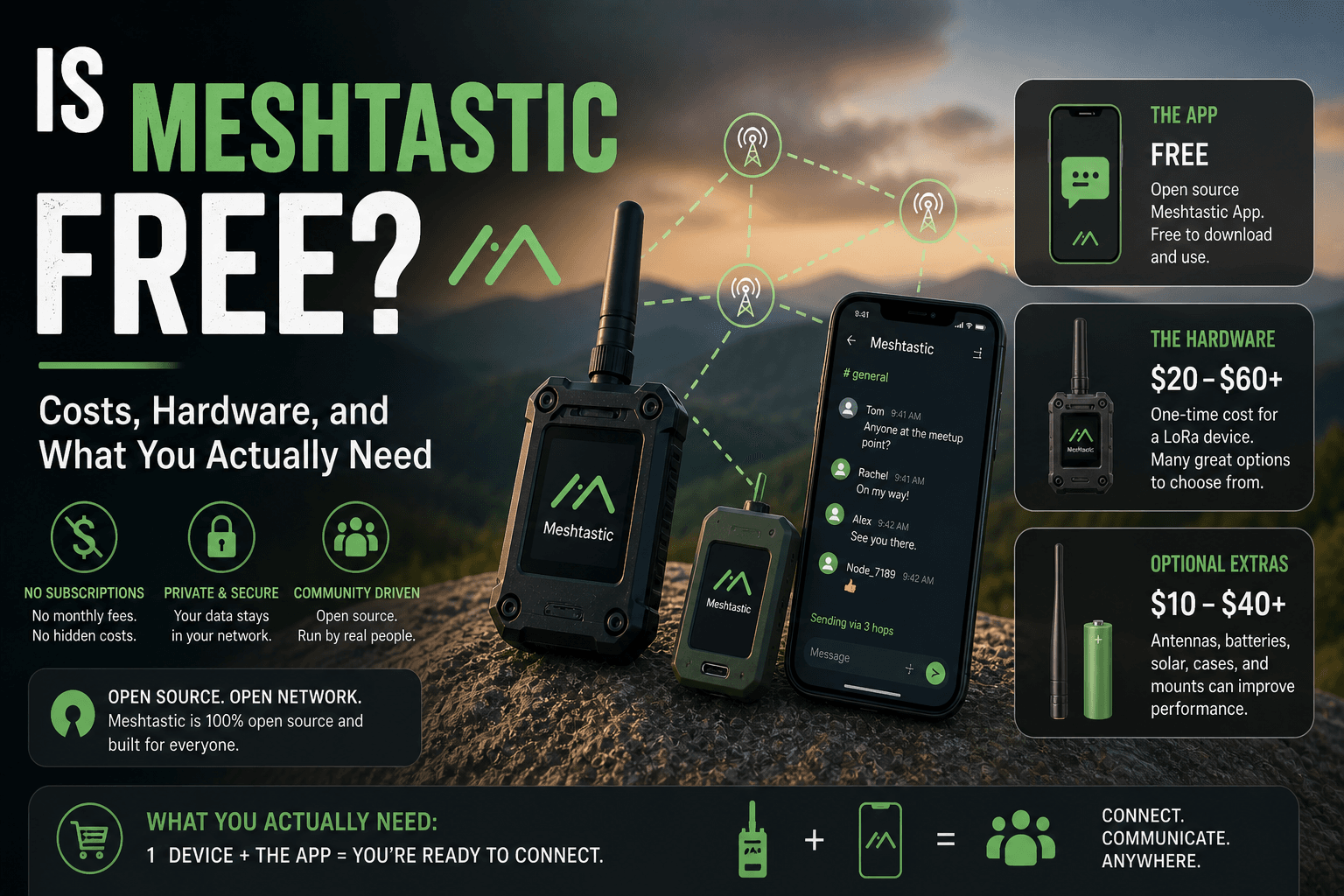
Short answer: the software is completely free. No subscription, no licence fee, no in-app purchases. But Meshtastic runs on physical radio hardware, and that hardware costs money. So the real question is not whether Meshtastic is free, but how much it actually costs to get started.
The honest answer is: not much. Less than a decent meal out for a basic setup. Here is what you actually need.
The software costs nothing
Meshtastic is open-source software, freely available on GitHub and through the official app stores. The firmware that runs on your devices is free. The Android and iOS apps are free. The web client is free. There are no tiers, no premium features locked behind a paywall, no monthly fees of any kind.
The project is maintained by a community of volunteers and contributors, with no commercial entity charging for access. If someone is selling you a Meshtastic subscription, something has gone wrong.
What you do need to buy: the hardware
Meshtastic needs a LoRa radio device to function. Your phone connects to it over Bluetooth, but the radio hardware does the actual transmitting and receiving. Without a physical node, you have an app and nowhere to go.
The good news is that this hardware is cheap. A basic Meshtastic-compatible device typically costs between 20 and 40 pounds. Some go a little lower, some go higher depending on features, but that is the realistic range for something that works well.
Popular options include devices from LILYGO (the T-Beam and T-Echo are common choices), RAK Wireless, and Heltec. These are small microcontroller boards with a built-in LoRa radio chip. Most come ready to flash with Meshtastic firmware, and many arrive with it already installed.
The minimum viable setup
To get on the Meshtastic network and communicate with others, you need exactly two things:
One Meshtastic-compatible node (20 to 40 pounds)
A phone with the free Meshtastic app installed
That is it. If someone near you is already running a node, you can communicate with them immediately. If you are setting up a private network with a friend, you both need a node each.
Many people buy two nodes to start with, one for themselves and one to leave running at home as a fixed relay. Two nodes puts you in the 40 to 80 pound range for a complete working setup.
What GPS adds to the cost
Some Meshtastic nodes include a built-in GPS chip. This lets the device broadcast its location to others on the network, which is useful for tracking, hiking groups, and situations where knowing where everyone is matters.
GPS-capable devices cost a bit more, typically 35 to 55 pounds. If you do not need location sharing, a GPS-free node does everything else just as well and saves a little money. Your phone can also supply GPS data to a non-GPS node over Bluetooth, so you are not entirely without position information even on cheaper hardware.
Optional extras worth knowing about
The baseline hardware works out of the box with its stock antenna, but the antenna that ships with most devices is genuinely poor. A decent aftermarket antenna costs 5 to 15 pounds and can dramatically improve range. For most people, this is the single best upgrade and should be considered part of the real cost of a useful setup.
A waterproof case or enclosure is worth having if the node will live outdoors or in a bag. You can 3D print one, buy a generic IP65 project box, or pick up a purpose-built enclosure. Budget 5 to 20 pounds depending on how polished you want it to look.
For fixed nodes, a small solar panel and battery can make the whole thing self-sufficient. A basic solar setup capable of running a node indefinitely costs 20 to 40 pounds. This is optional, but it is a compelling option for rooftop or garden installs.
Realistic total costs at each level
To put numbers to it:
Getting started, one node and a phone app: 20 to 40 pounds
A proper two-node setup with better antennas: 50 to 90 pounds
A GPS node plus a fixed relay with solar: 80 to 130 pounds
Compare that to a satellite communicator subscription, which often runs 15 to 50 pounds per month, and Meshtastic starts to look very attractive. The hardware is a one-time purchase with no ongoing cost whatsoever.
No ongoing costs at all
This is worth stating plainly. Once you have the hardware, Meshtastic costs nothing to run. There is no SIM card, no data plan, no server you are connecting to, no company that can change its pricing or discontinue the service. The network exists as long as the devices are running, and the devices run on a small battery or USB power.
You own the hardware. You control how it is used. The only ongoing cost is the occasional battery charge.
For anyone who has been put off by the monthly cost of commercial off-grid communicators, that distinction matters quite a lot.