
Your phone signal drops, and you're ten kilometres from the nearest town. The person you need to reach is somewhere over the ridge. Bluetooth barely makes it across a room, and WiFi is out of the question. You need something that works over distance, runs on a battery, and requires no infrastructure between you.
That gap is exactly where LoRa lives.
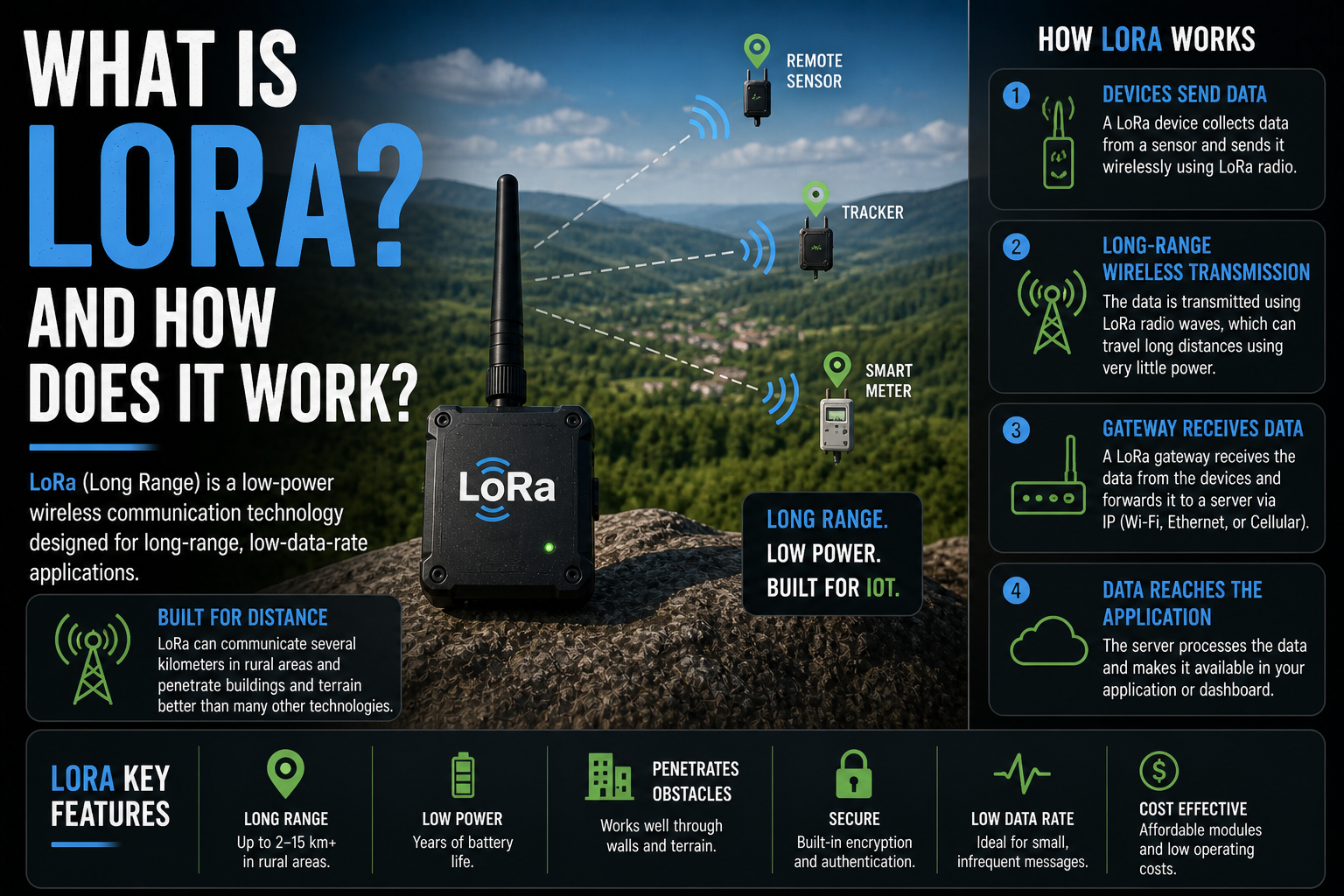
LoRa, short for Long Range, is a radio modulation technique designed to send small amounts of data over very long distances while using very little power. If you have been reading about Meshtastic, IoT sensors, or LoRaWAN networks, you have probably come across it. But what actually is it, and why does it work so well where other radio technologies fall short?
LoRa is a modulation technique, not a protocol
This distinction matters. LoRa is not a network standard, a cloud platform, or a communications protocol. It is a method of encoding information into a radio wave. Everything else, from LoRaWAN's gateway architecture to Meshtastic's peer-to-peer mesh, is built on top of it.
A French company called Cycleo developed the technology; Semtech acquired it in 2012. Semtech holds the patents and manufactures the LoRa chips that power everything from environmental sensors on farms to the Meshtastic device in your backpack.
How it actually works: chirp spread spectrum
The trick behind LoRa's remarkable range is a modulation method called chirp spread spectrum, or CSS. Most radio transmitters send data on a fixed, narrow frequency. LoRa does something different: it sweeps the signal continuously across a range of frequencies, producing a rising or falling tone called a chirp.
A receiver tuned to the same pattern can decode the chirp even when the signal is far weaker than the background noise. That is the clever part. Because the energy is spread across the whole bandwidth rather than concentrated at a single point, the receiver has much more to work with, even when the raw signal level is tiny.
This is why LoRa can extract useful data from signals that would register as pure static on anything else. That resilience to interference and noise is what lets it function at ranges where other low-power radio technologies give up.
Three settings you will need to understand
Three parameters control how LoRa behaves, and every deployment involves some balance between them.
Spreading factor controls how many chirps are used to encode each bit of data. A higher spreading factor means more chirps per bit, making the signal easier to decode at extreme range, but each transmission takes longer. SF7 is fast and short-range. SF12 is slow but can reach several kilometres even through buildings and hills.
Bandwidth is the width of the frequency sweep. A wider bandwidth carries data faster but needs a stronger signal. A narrower bandwidth is more sensitive and works at a greater range, at the cost of slower throughput. Most Meshtastic configurations use 125 kHz or 250 kHz.
The coding rate adds redundancy to the transmission, serving as a built-in error check. Higher coding rates improve reliability in noisy environments at the cost of a small reduction in speed.
These three settings together determine two things: the link budget (how far the signal can realistically travel) and the time on air (how long each packet takes to transmit). Get the balance right, and you have a reliable long-range link on a coin cell. Get it wrong, and you will be sitting at SF12 wondering why your sensor only sends one reading every two minutes.
The real limitations
LoRa is not fast. A typical packet carries a few hundred bytes over several seconds. That is perfectly adequate for a GPS position, a temperature reading, or a short text message. Streaming audio or sending a photo over LoRa is not a sensible idea.
In Europe, devices operating in the 868 MHz band are generally limited to transmitting for about 1% of the time in most sub-bands. Send too often, and you hit the duty cycle limit before your sensor has done anything useful. This is a genuine constraint, not just fine print, and any serious deployment needs to account for it.
Range also depends heavily on the environment. Open water or flat farmland can produce 10-km links with little effort. A dense city, with buildings and RF interference everywhere, will typically cut that to a kilometre or two, sometimes less. Height helps enormously: a node on a rooftop with a clear line of sight will outperform one on a windowsill every time.
What LoRa connects to
LoRa modulation is the foundation. Everything else is a choice about how to use it.
LoRaWAN is a network protocol built on LoRa that adds device registration, server infrastructure, and multi-gateway routing. It is the standard approach for commercial IoT deployments: sensors talk to gateways, gateways forward to a network server, and the data ends up in your dashboard.
Meshtastic takes a different route: a peer-to-peer mesh in which devices relay messages to one another, with no central server required. It uses the same LoRa chips and radio modulation, but the software is built for direct communication between people rather than for sensor data collection.
The chip inside a Meshtastic node and the chip inside a commercial LoRaWAN sensor are often identical hardware. What changes is the firmware and the network model built around it.
Why this matters for makers and experimenters
LoRa chips are cheap, widely available, and supported by an enormous open-source ecosystem. A basic dev board with a LoRa radio costs less than a coffee. The Meshtastic firmware is free, actively maintained, and runs on a wide range of hardware. Semtech's reference designs and the LoRaWAN specification are publicly available.
That combination of low cost, long range, and open tooling is why LoRa has become the default choice for anyone building their own IoT sensors or off-grid communication networks.
LoRa works because it makes a deliberate trade: it gives up speed in exchange for range and power efficiency. For most IoT and off-grid use cases, speed was the least you needed. Once you accept that trade, the number of things you can build starts to look very large indeed.