
You order a LoRa module online. The parcel arrives. You open the documentation and immediately hit terms like "LoRaWAN activation", "network server", and "OTAA join procedure". Hang on. Is LoRaWAN just LoRa with a longer name? Is it an upgrade? A different product entirely?
This confusion is one of the most common stumbling blocks in the LoRa world, and most explanations either oversimplify or bury the answer in protocol spec sheets.
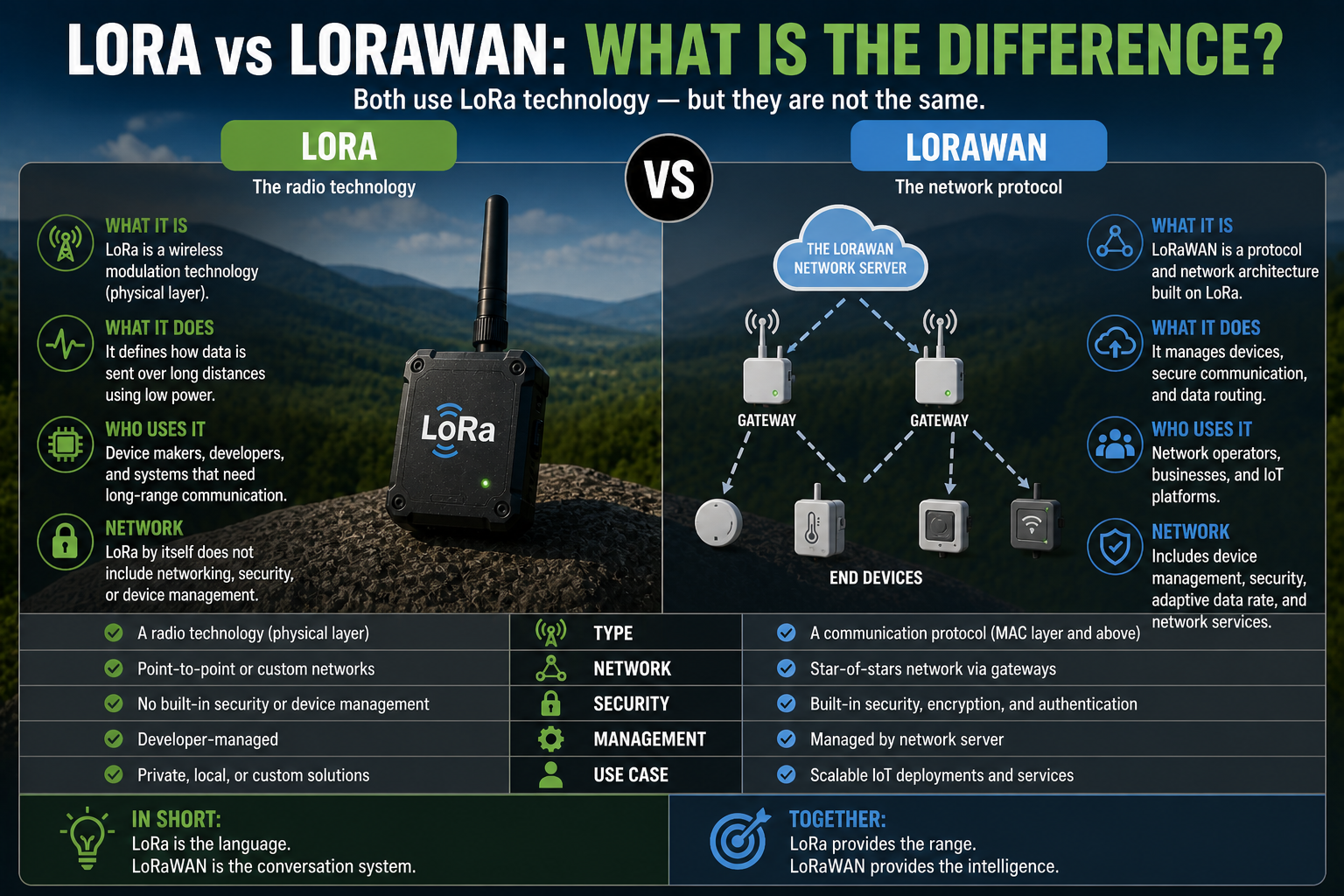
Here is the clear version: LoRa is a radio technology. LoRaWAN is a network protocol built on top of that radio technology. One is the physical layer, the other is everything above it. Understanding the difference between LoRa and LoRaWAN will make every piece of documentation you read from here on suddenly make a lot more sense.
What LoRa actually is
LoRa, short for Long Range, is a way of modulating radio signals. A French startup called Cycleo developed it; Semtech later acquired it and manufactures the chips found in almost every LoRa device you will encounter.
The clever bit is something called chirp spread spectrum. Instead of transmitting on a fixed frequency, LoRa sweeps its signal across a range of frequencies in a continuous rising or falling pattern. A receiver tuned to that same pattern can decode the message even when the signal is far weaker than the background noise around it. That is why LoRa achieves the range it does at such low power: it pulls useful data out of signals that would register as static on a conventional radio.
LoRa is purely a physical layer technology. It describes how bits become radio waves. It says nothing about how devices are addressed, how messages are routed, how data is encrypted, or how acknowledgements are confirmed. Those are problems for whatever protocol sits on top of it.
What LoRaWAN adds
LoRaWAN is an open network specification managed by the LoRa Alliance. It defines everything that LoRa deliberately leaves out: how devices join a network, how packets are structured, how encryption keys are managed, how gateways relay traffic to a server, and how that server coordinates the whole thing.
A LoRaWAN deployment has three distinct layers:
End devices (sensors, trackers, or other low-power hardware) transmit LoRa packets
Gateways receive those packets and forward them over the internet to a network server
The network server handles deduplication, decryption, and routing to your application
The device itself never connects to the internet. It just broadcasts, and the surrounding infrastructure picks it up. If you are in a city with good LoRaWAN coverage, a sensor can transmit data to a cloud platform without you needing to own or operate a single gateway.
A useful mental model: LoRa is the postman's legs. LoRaWAN is the entire postal system, including addresses, sorting offices, and delivery confirmation.
Why the same hardware can run both
LoRa hardware is protocol-neutral. An SX1276 radio chip, which powers the vast majority of affordable LoRa modules, can run LoRaWAN firmware, Meshtastic, or any custom protocol you write yourself. The chip does not care. The software decides.
This is exactly why the terminology gets tangled. When someone says "I use LoRa", they might mean a LoRaWAN node connected to The Things Network, a Meshtastic device running peer-to-peer mesh, or a simple point-to-point link between two ESP32 boards in a garden. All three use the same underlying radio technology. They are doing completely different things with it.
When you would use raw LoRa without LoRaWAN
Many good projects never involve LoRaWAN at all. If you control both ends of a link and you are sending simple data between two known devices, raw LoRa is faster to set up and gives you more flexibility over packet structure and timing.
Meshtastic is the most prominent example. It uses LoRa as its radio layer but runs its own peer-to-peer mesh protocol on top. No gateways, no network server, no internet connection required. Devices find each other and pass messages along through the mesh, building coverage from the nodes themselves rather than from fixed infrastructure.
Point-to-point sensor links, remote weather stations, home automation bridges: all are legitimate LoRa use cases that never touch LoRaWAN.
When LoRaWAN is the right choice
LoRaWAN is designed for scale. If you need dozens or hundreds of sensors spread across a building, a farm, or a city, all reporting to a central platform, LoRaWAN gives you the architecture to manage that cleanly.
The network server handles device registration, deduplication across overlapping gateway coverage, and the decryption of each packet. You also get access to existing public infrastructure. Community networks like The Things Network have gateways covering large portions of many cities, which means you can often deploy a sensor and have it working without setting up any gateway hardware yourself.
Security is another strong point. LoRaWAN uses AES-128 encryption at two separate layers: one between the device and the network, and one between the device and your application. With raw LoRa you have to implement your own encryption if the data is in any way sensitive.
The honest trade-offs
LoRaWAN is not simply "better" than raw LoRa. It solves a different set of problems.
For small-scale or off-grid use, LoRaWAN's infrastructure requirements are overhead with no benefit. You need gateways connected to the internet, a network server (either self-hosted or provided by a third-party service), and a registration process for every device. That is perfectly reasonable for a commercial deployment of many sensors. It is a lot of friction for a mesh network used on a hiking weekend.
Raw LoRa is simpler, faster to get running, and works entirely offline. The downside is that routing, deduplication, and security all need to come from somewhere else. That somewhere else is usually a project like Meshtastic, or your own code.
There is also a practical overhead that catches people out: LoRaWAN requires managing security keys for every device. OTAA (Over the Air Activation) and ABP (Activation By Personalisation) are the two methods, and both involve provisioning keys correctly before a device can join a network. With raw LoRa, you skip all of that.
What this means for Meshtastic users
If you use Meshtastic, you are in the raw LoRa camp. Meshtastic borrowed the radio technology but built an entirely different network on top of it, one that requires no gateways, no servers, and no internet connection to function. The firmware handles routing and encryption itself.
That architectural choice is not a limitation. It is the point. It is exactly what makes Meshtastic useful in situations where LoRaWAN infrastructure does not exist and cannot be built in time.
Once the distinction between LoRa and LoRaWAN clicks, a lot of IoT documentation that previously looked like noise starts to make sense. Gateways, network servers, activation modes: that is LoRaWAN territory. Mesh routing, off-grid messaging, and spreading factors for maximum battery life: that is the world Meshtastic lives in.
Both are built on the same radio. One of them needs a city's worth of infrastructure to work. The other just needs your friends to have one too.