
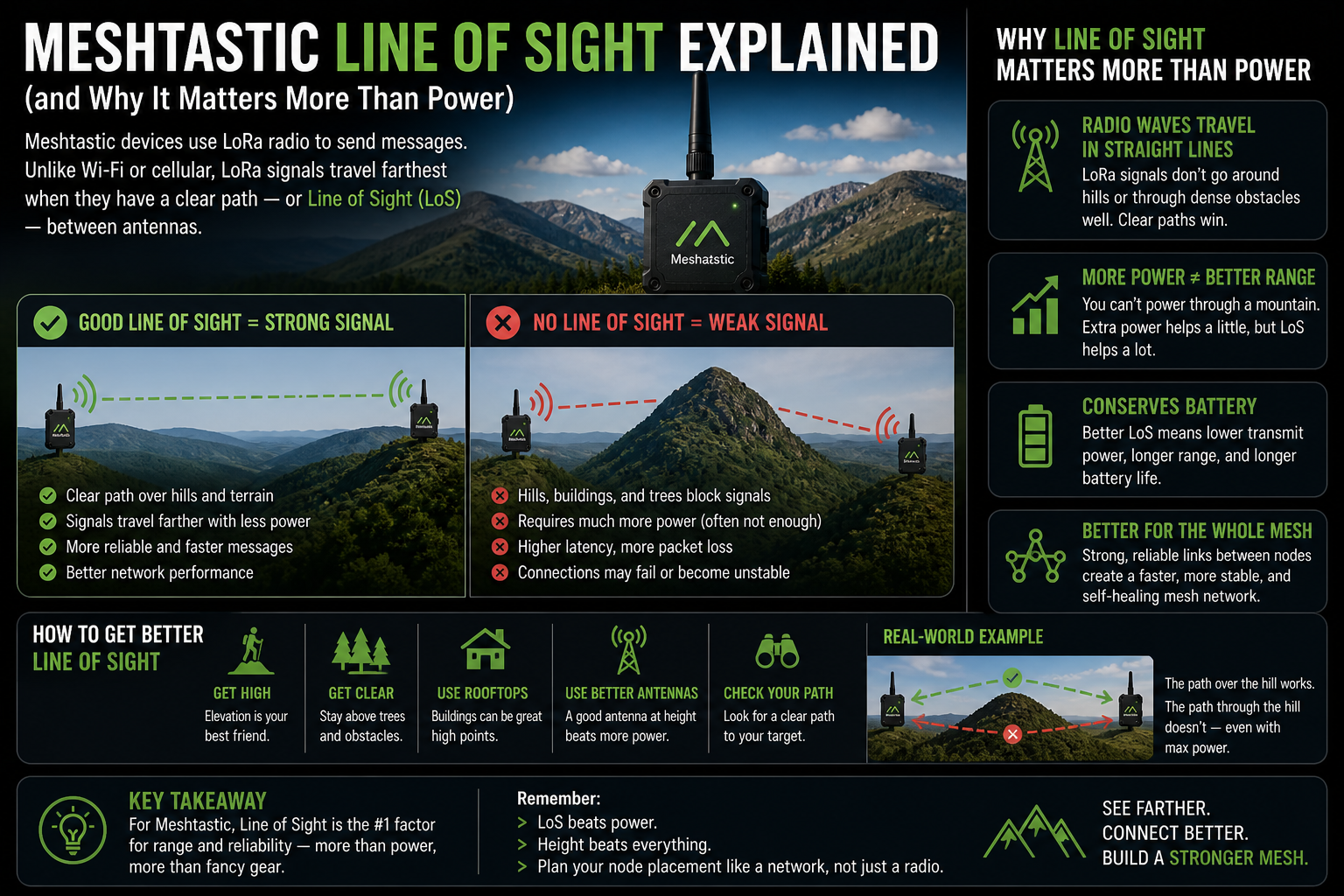
You have probably read that LoRa signals can travel 10 or 20 kilometres. You have probably also tried it, achieved something far less impressive, and wondered what went wrong. Before checking your antenna, before tweaking your power settings, there is one thing worth understanding properly: line of sight, and why it explains more about Meshtastic range than almost anything else.
Meshtastic line of sight is not just a tip buried in a list of optimisation advice. It is the single biggest factor in whether a radio link works at all. Getting more transmit power is a minor adjustment. Getting clear line of sight is often the difference between a link existing and not existing.
What "line of sight" actually means for radio
The obvious interpretation is that two antennas can see each other if you stood at one and looked toward the other. That is the geometric line of sight, and it matters. But radio adds a complication: the signal does not travel along a single line. It spreads out into an elliptical volume around that line, and the whole volume needs to be reasonably clear for the link to perform well.
This volume is called the Fresnel zone. Imagine a stretched football shape between your two antennas, with the widest point in the middle of the path. For a 5 km link at 868 MHz, the Fresnel zone is several tens of metres wide at its widest. If a building, a hillside, or a dense stand of trees cuts through that zone, the signal is attenuated even if the geometric line of sight is technically clear.
This is why raising a node by just 10 metres can produce a remarkable improvement in range: you are not just moving the antenna slightly. You are lifting the entire Fresnel zone clear of the obstacles below it.
Why LoRa is good at non-line-of-sight, but not immune to it
LoRa is often described as having strong non-line-of-sight (NLOS) performance, and compared to Bluetooth or 5 GHz WiFi, this is true. Its sub-gigahertz frequencies penetrate building materials better than higher-frequency technologies, and its chirp spread spectrum modulation allows the receiver to decode very weak signals. You can bounce a message off a building, punch it through a few walls, and still get through.
But "better NLOS than WiFi" is a low bar when you are trying to cover kilometres. Every obstacle in the Fresnel zone costs you signal. Trees in full leaf cost several decibels per hundred metres of dense canopy. A brick wall costs 10 to 15 dB depending on construction. A solid hillside is simply a blocker: the signal diffracts around it slightly, but the loss is severe enough that only the best-placed nodes on the longest path stand any chance.
The result is that LoRa is forgiving of partial obstruction over short distances, but ruthless about it over long ones. At 500 metres, punching through a few walls is fine. At 5 kilometres, a ridge between you and the other node is a showstopper, regardless of power or antenna.
Why height beats power, every time
Here is the comparison the title promised.
When you double your transmit power, you add 3 dB to your link budget. That is a real improvement, but in signal terms it is modest: 3 dB is roughly equivalent to shrinking the distance between two nodes by about 30%.
When you raise your antenna from desk height to a rooftop, you might add 10, 15, or 20 dB of effective link margin, not because the radio is transmitting harder, but because the path between the two antennas has gone from cluttered to clear. You have replaced a signal that had to fight through layers of obstruction with one that travels mostly through air.
There is a useful concept here called the link budget: a running total of all the gains and losses between transmitter and receiver. Transmit power adds to it. Antenna gain adds to it. Obstacles, cable losses, and distance subtract from it. What matters is the total. And clearing even partial Fresnel zone obstruction is often worth more to the total than any realistic increase in transmit power.
This is not a small effect. A Meshtastic node on a windowsill in a semi-detached house, trying to reach another node three streets away, might have 20 to 30 dB of losses from buildings, trees, and terrain. Maxing out the transmit power adds 3 dB. Moving the node to the roof clears those losses entirely. Same hardware, completely different result.
Terrain is the thing you cannot fix
Buildings and trees can often be worked around with better placement. Terrain is harder.
A hill or ridge directly between two nodes creates what is called knife-edge diffraction. Some signal bends around the edge, but the losses are steep. In practice, a ridge between two handheld nodes at ground level on either side of a hill usually means no link, full stop. Not a weak link, not an unreliable one: no link.
This is why hilltop repeater nodes have such an outsized effect on Meshtastic networks. They are not just a bit higher up. They have line of sight to large areas on both sides that cannot see each other at all from ground level. A single node on a good hill can bridge two valleys that would otherwise be completely isolated, connecting users who have no path to each other by any other route.
Valleys are the mirror problem. A node at the bottom of a valley surrounded by hills on all sides is in a near-perfect RF dead zone. It can reach other devices in the same valley, but the walls cut off everything beyond. Moving a metre up the valley side helps slightly. Getting above the ridgeline helps enormously.
Urban line of sight: a different problem
In cities, the terrain is mostly flat but the obstructions are dense and close together. Street-level nodes face a different version of the same challenge: every building is a blocker, and the Fresnel zone rarely has any room to breathe.
Urban Meshtastic performance is often characterised by islands of coverage centred on elevated nodes, with patchy ground-level connectivity between them. A node on a rooftop with a clear view of several streets can cover a large area that would fragment completely if every node were at street level.
The practical implication is the same as in open country: elevation is the fix. In cities, "elevation" means rooftops, upper floors with good window placement, or antennas on high buildings. The aerial-on-the-roof pattern that mobile operators use for their base stations exists for this exact reason.
How to think about placement before spending money
Before buying a better antenna or a device with higher transmit power, spend five minutes thinking about the path between your node and the nodes you want to reach. Is there a hill in the way? A dense block of buildings? A ridge that both nodes sit behind?
If yes, the link will not work well regardless of hardware. The right fix is to change the geometry: raise one or both endpoints, or add a node at height between them that has line of sight to both.
If the path is reasonably clear and range is still disappointing, then antenna quality and placement become the next area to look at. A well-matched antenna pointed in the right direction at decent height will outperform a poor antenna at the same height by several dB. But neither antenna choice matters much if the Fresnel zone is buried in a hillside.
The impressive long-range Meshtastic links you see documented online almost always share one thing: both ends are high up, with a largely unobstructed path between them. Open water, flat farmland, or two hilltops facing each other. That is not luck, and it is not exotic hardware. It is line of sight, doing what line of sight does.
The bigger picture
Understanding line of sight changes how you think about Meshtastic network design. Instead of asking "how powerful is my node?", you start asking "what can my node see?" Those are very different questions, and the second one is far more useful.
A modest node at height with a standard antenna and clear line of sight will outperform a high-power node buried in a valley in virtually every scenario. The radio does not care how much power you throw at a hillside. The physics do not negotiate.
Placement is not just a factor. For anything beyond short-range, it is the factor. Get that right first, and everything else follows.