
You are three days into a hike, deep in an area where mobile reception stopped existing sometime yesterday. Your hiking partner is two ridges ahead. You need to let them know you are running late. In that situation, most communication tools fail completely.
Meshtastic does not. And the way it manages that is worth understanding, because it is not a magic trick. It is a set of clever, practical engineering decisions that add up to something quite useful. This is how off-grid messaging with Meshtastic actually works.
What Meshtastic actually is
Meshtastic is open-source software that runs on small, low-cost radio hardware. The hardware broadcasts and receives radio signals using a technology called LoRa, which stands for Long Range radio. The software turns a collection of these devices into a mesh network, where every device can relay messages for every other device.
You interact with it through a phone app, connected to your device over Bluetooth. The app is your interface. The hardware is the radio. Together they let you send text messages, share your GPS location, and communicate with other people running the same setup, without touching any mobile or internet infrastructure at all.
The hardware: small, cheap, surprisingly capable
A Meshtastic node is typically a small circuit board with a LoRa radio chip, a microcontroller, and an antenna connector. The whole thing is often smaller than a deck of cards. Many popular options run for days or weeks on a small battery, and some people power fixed nodes from solar panels indefinitely.
Popular hardware includes devices built on the ESP32 and nRF52 microcontrollers, sold by manufacturers like LILYGO, RAK Wireless, and Heltec. Prices range from around 20 to 60 pounds depending on features like built-in GPS, screens, and enclosures. You do not need a licence to operate them in most countries, because they transmit at very low power within unlicensed frequency bands.
How messages travel without a network
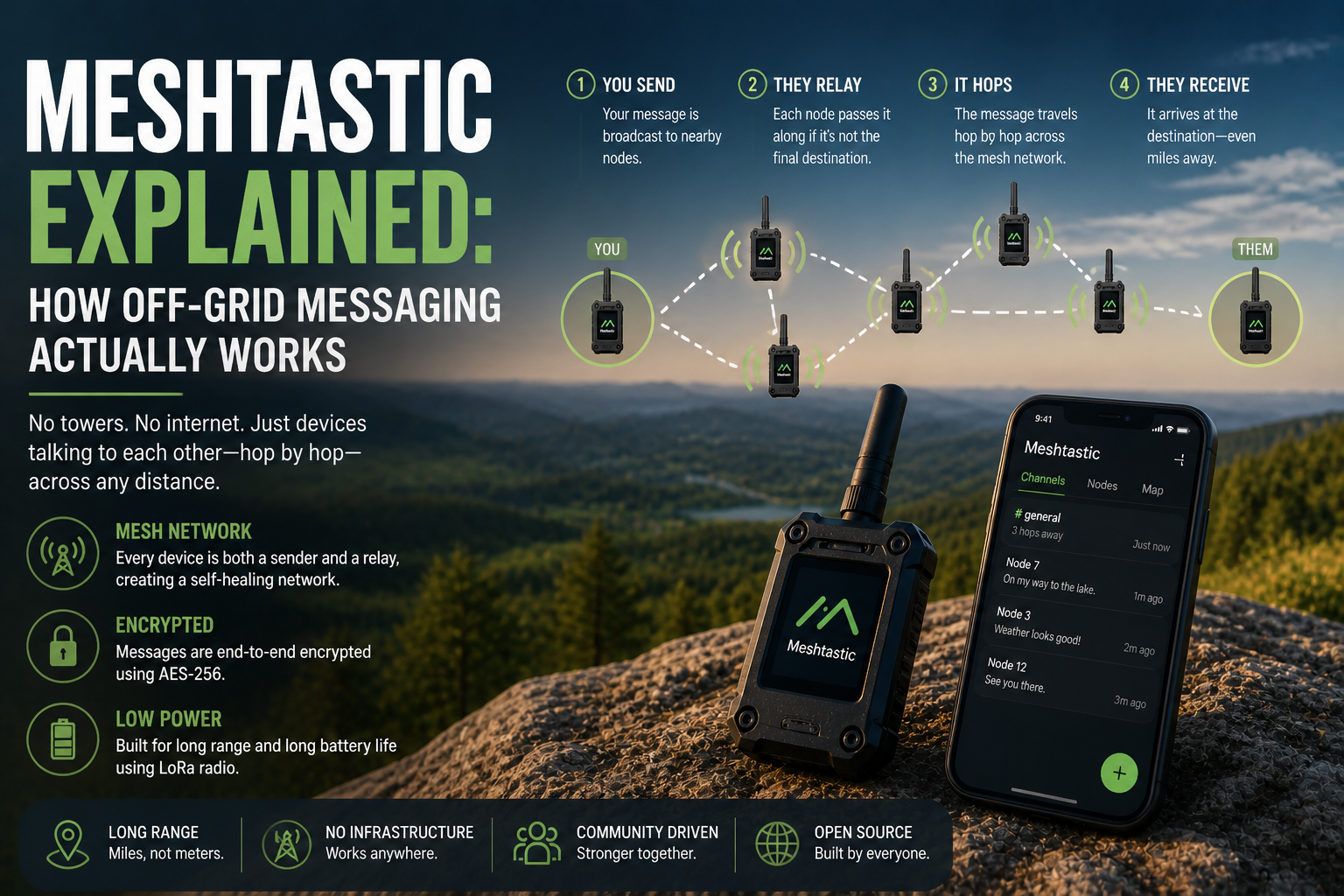
When you send a message, your phone passes it to your node over Bluetooth. Your node broadcasts it as a radio signal. Any other Meshtastic node within range picks up that signal and rebroadcasts it. The next node does the same. The message hops through this chain of devices until it reaches the destination, or until it has been relayed the maximum permitted number of times.
This process is called mesh networking. There is no central server routing anything. No single point that has to be up for the system to work. Each node in range participates automatically. If one node goes down, messages route around it through whatever other nodes are available.
The practical result is that two people who cannot directly hear each other can still communicate, as long as there are enough intermediate nodes between them. A person in a valley and a person on a hilltop, separated by terrain that blocks their direct radio path, can exchange messages via a node sitting on the ridge between them.
What LoRa actually does for range
LoRa is not a high-bandwidth technology. It cannot stream audio or video. It sends small packets of data at relatively slow speeds. What it does exceptionally well is reach long distances at very low power.
It achieves this through a technique called spread spectrum modulation, which spreads the signal across a wider frequency range than strictly necessary. This makes it extremely resistant to noise and interference, and allows receivers to pick up signals that are far below what conventional radios would consider usable. In practice, a single LoRa link can cover several kilometres in a suburban area, and considerably more in open terrain with good antenna placement.
For messaging, that trade-off is perfect. You do not need speed. You need reach and reliability on tiny batteries.
Channels and encryption
Messages on Meshtastic are sent on channels, each protected by AES-256 encryption. The default channel uses a shared key that all devices know. For private communication, you can create a channel with a custom key and share it only with the people you want to communicate with.
Anyone with a Meshtastic device can hear the radio transmissions, but without the matching channel key they cannot read the content. The encryption is not an optional extra: it is baked into how the system works.
Location sharing alongside messaging
Many Meshtastic nodes include a GPS chip, and the software has built-in support for broadcasting your position to others on the same channel. The phone app displays everyone's location on a map, updating automatically as nodes move or check in.
This turns the network into something more than just a text channel. For a hiking group spread across a hillside, or a team working across a large site, being able to see where everyone is without any phone signal is genuinely useful. You can configure how frequently nodes broadcast their position to balance visibility against battery life and radio traffic.
The network gets better with more people
This is the aspect of Meshtastic that people often find surprising: it is a community-built network. Every person who sets up a node and leaves it running, whether on a windowsill at home or mounted on a rooftop, is contributing to the network for everyone around them.
A single node in a new area gives you the ability to communicate with anyone else who happens to be nearby with their own device. A dozen nodes spread across a town create a mesh that can carry messages across the whole area, with no central authority, no subscription fee, and no single operator who can switch it off.
It is not trying to replace mobile networks for everyday use. But for the situations where mobile networks fail, or for communities that want a resilient local communication layer that belongs to them, the model is quietly compelling.
What it cannot do
Being honest about the limits matters. Meshtastic is not fast. Messages can take several seconds to arrive, especially if they are hopping across multiple nodes. It is not designed for long messages, file transfers, or anything requiring real-time back-and-forth.
Range is impressive for the technology, but it is still radio. Hills, buildings, and dense trees all reduce it. In a sparsely populated area with few other nodes, you are largely limited to what your device can reach directly.
And it requires everyone involved to have compatible hardware and the app set up in advance. It is not a drop-in replacement for a phone call.
Why it matters beyond the niche
What makes Meshtastic interesting beyond its immediate use cases is what it represents: a working demonstration that useful communication infrastructure does not have to be owned, operated, or controlled by anyone. It can emerge from a group of people who each contribute a small node and share a common protocol.
That idea has value in emergency preparedness, in remote communities, in events and festivals, and in any situation where existing infrastructure is unavailable, unreliable, or simply not trusted. The hardware is cheap enough that getting started costs less than a round of drinks. The learning curve is shallow enough that most people have it working within an afternoon.
Once it clicks, the appeal is obvious.