
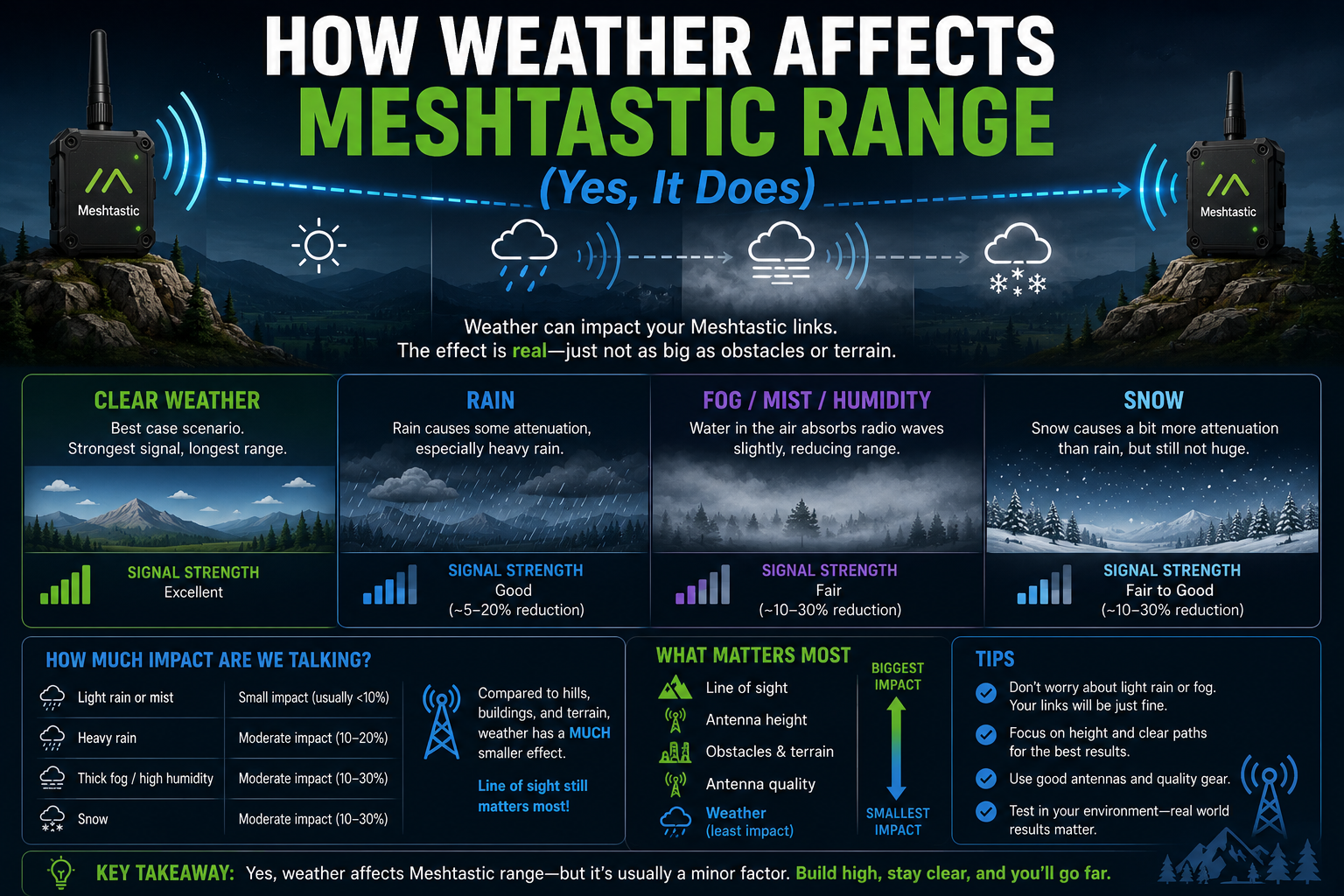
You set up a Meshtastic node with a good line of sight, tested it on a dry afternoon, and were happy with the range. A week later, after a few days of rain, the same two nodes can barely hear each other. Nothing changed. Except the weather did.
Weather absolutely affects Meshtastic range, but the mechanisms are more interesting than you might expect. Some are obvious in hindsight. Some are genuinely counterintuitive. And at least one means your mesh can sometimes reach further in bad weather than in good.
Rain itself is mostly not the problem
The first instinct is to blame the rain directly. And at some frequencies, that is exactly right. Satellite links, microwave backhaul, anything above roughly 10 GHz loses significant signal when rain fills the air with tiny water droplets. The physics is straightforward: at those frequencies, the wavelengths are small enough that raindrops scatter the signal.
But Meshtastic uses 868 MHz in Europe and 915 MHz in the US. Those frequencies have wavelengths around 30 cm, which is much larger than a raindrop. Rain absorption at LoRa frequencies is measurable but small. A heavy downpour might cost you a decibel or two over a long path. For most practical Meshtastic links, that is well within the margin and unlikely to cause a dropout on its own.
So if rain is not the direct culprit, what is?
Wet vegetation is
Foliage is one of the biggest sources of signal loss in suburban or woodland environments, and wet foliage is considerably worse than dry foliage. Leaves absorb and scatter RF energy, and when they are coated with water, that absorption increases noticeably. A hedgerow that costs a few dB in summer can cost significantly more after a soaking, enough to take a marginal link and turn it into a failed one.
This is why links that look reliable on a clear day can become inconsistent after rainfall, even when your line of sight assessment was done carefully. The path that appeared clear was actually threading through trees or crossing dense gardens. The vegetation was always there. The rain made it matter more.
If you have a link that routinely degrades after rain, suspect wet foliage first. Raising the antenna height on either end, even by a few metres, can lift the signal above the worst of the canopy and restore the margin.
The counterintuitive case: when bad weather helps
On some mornings, usually cool and still after a warm evening, Meshtastic nodes that are normally well out of range of each other suddenly connect. Messages hop further than expected. RSSI values look better than your antenna setup has any right to produce.
This is a temperature inversion, and it can extend LoRa range quite dramatically. Normally, air temperature drops with altitude. In an inversion, warmer air sits above cooler air near the surface. This creates a layer where the atmosphere's refractive index changes, bending radio waves back toward the ground rather than allowing them to escape upward.
The result is something called tropospheric ducting. Radio signals that would normally be lost into the sky instead hug the Earth's surface and travel much further than the geometry of the link would suggest. Unusually long Meshtastic links, dozens of kilometres from relatively low-height nodes, often turn out to be ducting events rather than exceptional hardware.
It is not something you can rely on for a permanent network design. But if you notice your mesh behaving strangely well on a cool, still, humid morning, ducting is probably why.
Cold, ice, and what it does to hardware
Cold itself has minimal effect on RF propagation in the frequency range Meshtastic uses. What it does affect is hardware. Batteries lose capacity in the cold, sometimes sharply. A node that runs a week on a charge in mild weather may last two or three days at temperatures below freezing. If you are running outdoor nodes through winter, the power budget matters more than the propagation.
Ice and snow building up on an outdoor antenna is a more direct problem. A thick ice coating changes the antenna's electrical length and detunes it, which shifts its resonant frequency away from where you need it. The effect varies with antenna design and the amount of ice, but a heavily iced antenna is meaningfully worse than a clear one. Dome-style radomes and weather-sealed housings help here.
Humidity and atmospheric pressure
Humidity has a small but real effect on RF propagation. Water vapour absorbs radio energy slightly, and very humid air has a marginally different refractive index than dry air. At the distances and frequencies Meshtastic works at, this is usually a minor contributor compared to vegetation and line-of-sight geometry.
Atmospheric pressure affects signal propagation primarily through its influence on temperature inversions and ducting, rather than directly. High pressure systems tend to bring the stable, temperature-stratified conditions that favour ducting. Low pressure and wind mix the atmosphere and eliminate those layers.
What this means in practice
For most Meshtastic deployments, weather is not the primary driver of range performance. Antenna height, obstructions, and node placement matter far more. But weather is real, and ignoring it leads to puzzling failures that are actually straightforward once you know what to look for.
Wet vegetation explains most of the "worked fine last week" problems. Temperature inversions explain the occasional surprise long-hop. Cold explains the winter battery drain. Ice explains why a permanently mounted outdoor antenna might need better housing.
If your link is working comfortably with a margin to spare, a bit of rain is unlikely to trouble it. If it is marginal on a dry day, assume the weather will eventually find that weakness.