
You're standing in a field with a Meshtastic node and a sense of optimism. Somewhere on the other side of town, your friend has another one. You send a message. Nothing. You try again. Still nothing. The range should be fine in theory, but the theory didn't account for the hill between you, the rows of terraced houses, or the fact that both nodes are sitting on a table at waist height.
The real question, when planning how many Meshtastic nodes you need for good coverage, is not how far the radio can reach in a perfect vacuum. It's how many nodes you need, and where, to cover the actual ground you're working with.
The honest answer: fewer than you think, but in better positions than you might expect.
What "coverage" actually means in a mesh
Meshtastic works by hopping messages between nodes. Every device in range of another can receive its packets and forward them on. A message that can't travel from A to B directly might get there through C, D, and E.
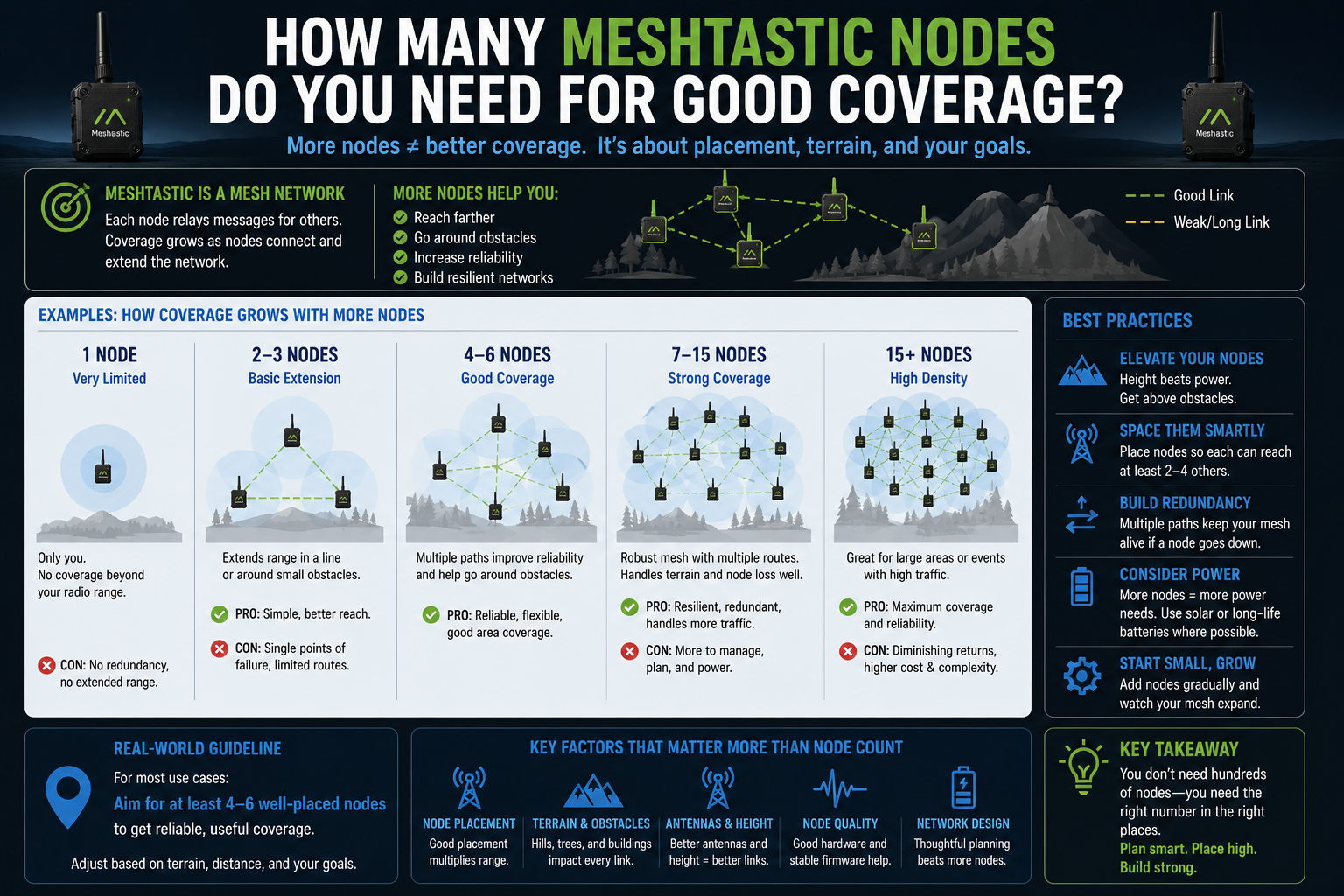
This is both the strength and the trap. People assume that more nodes equals more coverage. Sometimes that's true. Sometimes a tightly packed cluster of five nodes in a city centre gives you no more reach than two, because they're all close together with nothing to bridge the gap to the next neighbourhood.
Real coverage comes from nodes that can see each other over distance, not just nodes that happen to be near each other.
How range varies with terrain
A Meshtastic node in an open field with a decent antenna can realistically reach 5 to 10 kilometres to another node in a similar position. That's the best case.
In a typical suburb, expect 1 to 3 kilometres. Rows of houses, parked cars, trees in leaf, and the general clutter of built-up areas all eat into the signal. In a dense city centre, 500 metres through a row of concrete buildings can be a stretch.
Elevation changes the picture entirely. A node mounted on a rooftop or a hilltop can often reach five or six times as far as one sitting on a windowsill. This is why a single well-placed fixed node often does more for a network than three portable ones at ground level.
Node count for different scenarios
Rather than a single formula, think about what you're actually trying to cover:
A single outdoor event or campsite: 2 nodes is usually enough if the site is compact. One at each end, or one fixed and one roving.
A small town or village: 3 to 5 nodes, with at least one placed high, on a rooftop, a church tower, or the top of a hill overlooking the settlement.
A suburban area spanning several kilometres: 5 to 10 nodes, ideally with 2 or 3 acting as fixed router nodes at elevated positions, and the rest as portable clients.
A rural hiking area: Nodes at trailheads and hilltops. Open terrain means fewer are needed, but each one needs a clear line of sight to the next.
These are starting points, not hard numbers. Your actual terrain will tell you where the gaps are once you start testing.
The value of one good router node
If you can only invest in one fixed node, place it well before adding any number of portable ones. A single router node on a rooftop at 10 metres above ground level, with a decent antenna, can provide the backbone that makes everything else work.
In Meshtastic, you can assign each node a role. A Router node (or a dedicated repeater) prioritises forwarding messages over its own communication, uses less power, and is designed to sit quietly in one place doing useful work. A well-configured router node on a hill or rooftop can connect portable client nodes that would otherwise be completely out of range of each other.
Before adding a third or fourth portable node, ask whether what you actually need is one fixed node in a better position.
Placement beats quantity
The single biggest mistake new Meshtastic builders make is spreading nodes flat across the ground and then wondering why coverage is patchy. Radio doesn't travel well through walls, hills, and buildings when it's at the same height as them.
Getting a node up by even 5 metres changes everything. A small single-board computer with a LoRa hat and a decent external antenna mounted outside, even on a fence post at first-floor window height, will outperform several ground-level nodes.
Think about your terrain in three dimensions. Where are the high points? Where are the natural line-of-sight corridors? A node on a ridge between two valleys might bridge a gap that no number of valley-floor nodes could cover.
The honest reality check
More nodes does not always mean better coverage, and there is a point of diminishing returns. A dense cluster of nodes all in range of each other creates a lot of network chatter without extending the reach of the mesh. In a small area with many nodes all forwarding the same messages, you can actually cause congestion that slows delivery for everyone.
Meshtastic has mechanisms to manage this, including hop limits, message deduplication, and node roles that reduce unnecessary rebroadcasting. But the cleaner solution is to think about placement first and quantity second.
Also worth knowing: battery-powered portable nodes left in the field as semi-permanent infrastructure will eventually die. If you're planning a fixed deployment, plan your power source at the same time. Solar with a small LiPo battery pack is a common and reliable solution for outdoor nodes.
Where to start
If you're building a Meshtastic network from scratch, start with two or three nodes and actually test the gaps before adding more. Walk the area. Find where messages drop. Then figure out whether the gap is a distance problem or an obstacle problem that some elevation would solve.
Most small community networks get surprisingly good coverage from three nodes, two of which are fixed and elevated. Adding a fourth and fifth fills in the edges. Going beyond that is usually a choice you make because the network is genuinely growing, not because the original coverage was broken.
The mesh rewards thoughtful placement. A small, well-planned network usually beats a large, sprawling one. Start lean, test it properly, and let the actual gaps tell you what to add next.