
Picture this: you set up two Meshtastic nodes, one at each end of your house, to see if they can talk to each other. They connect immediately. You feel like a genius. Then you move one node into the basement and the other up to the attic, and suddenly messages start dropping. Concrete floors will do that.
The question of whether Meshtastic can work indoors is a reasonable one, and the honest answer is: yes, with caveats. LoRa radio signals are impressively good at punching through obstacles compared to Wi-Fi or Bluetooth, but they are not magic. Buildings fight back, and some buildings fight back harder than others.
LoRa signals and walls: a complicated relationship
LoRa operates on sub-gigahertz frequencies, typically 868 MHz in Europe and 915 MHz in the US. Lower frequencies generally penetrate solid materials better than higher ones. This is why a cheap FM radio still works inside a concrete building while 5 GHz Wi-Fi barely survives a brick wall.
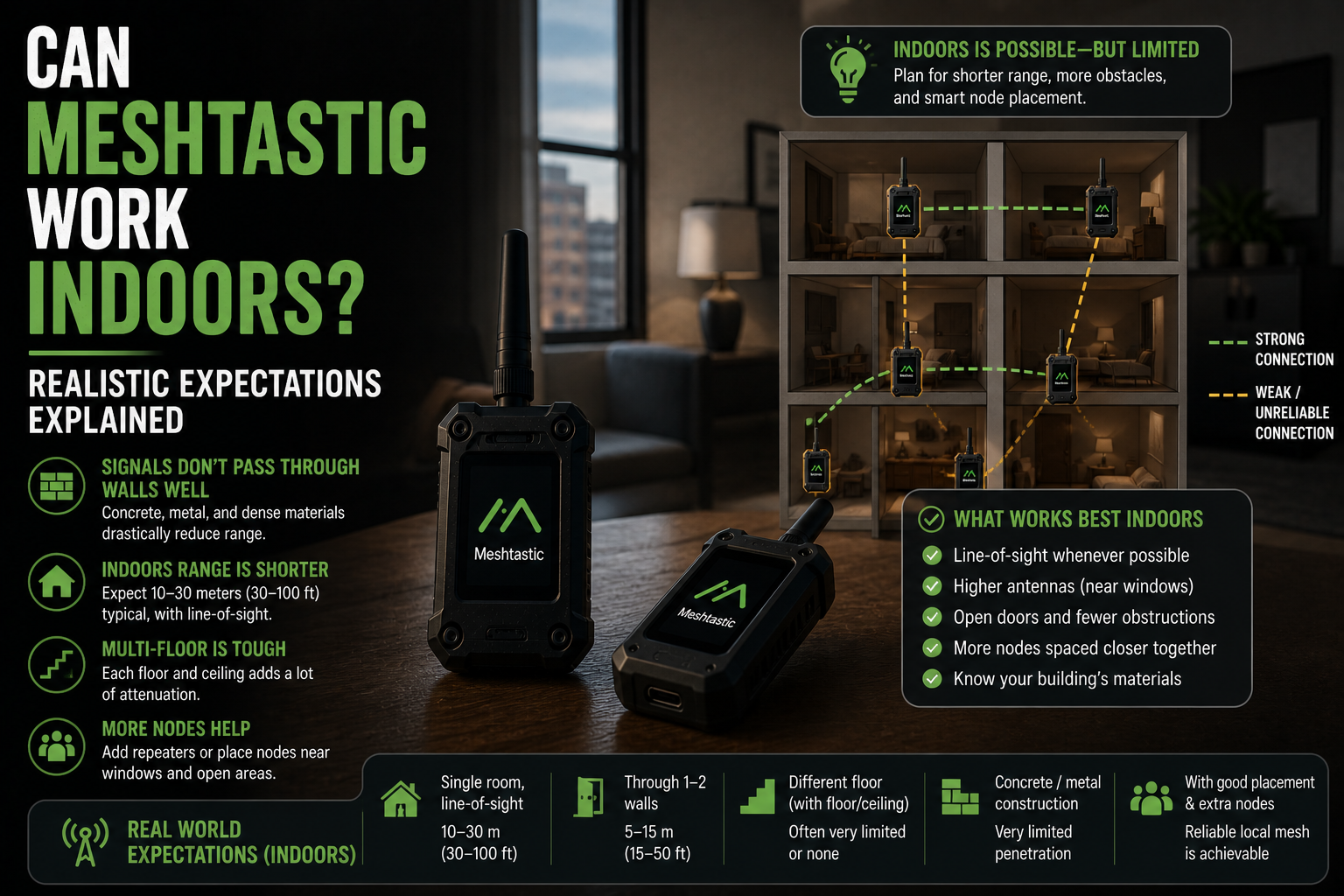
That said, every wall, floor, and ceiling still costs you signal. Each barrier absorbs and reflects some of the radio energy. Stack enough of them between two nodes and the link eventually fails. The question is not whether walls matter, but how many you can get away with.
A thin timber-frame wall with plasterboard on each side loses a few decibels. A concrete floor or a brick wall with a cavity loses significantly more. A reinforced concrete slab, the kind you find in multi-storey car parks or commercial buildings, is genuinely brutal. Some buildings are close to radio black holes at these frequencies.
What to expect in practice
In a typical UK or US home, two Meshtastic nodes on the same floor with a few internal walls between them will usually communicate fine. The signal margin is generous enough at short distances to absorb the losses.
Go up or down a floor and things get less predictable. Concrete floors are the main enemy. A wooden floor between a ground floor and a first floor is generally fine. Concrete is not.
In a small office or warehouse with an open floor plan, Meshtastic can cover a surprisingly large area indoors. Warehouses in particular tend to work well because the materials are often lightweight steel cladding rather than dense masonry, and there are few internal walls to fight through.
Dense urban offices, university buildings, and hospitals are harder. Thick concrete cores, lift shafts, and heavy fire doors can reduce indoor range to tens of metres between floors. On a single floor, a node placed in a corridor can often bridge between rooms that would otherwise struggle to reach each other directly.
Antenna placement changes everything
This is probably the most underappreciated factor in indoor Meshtastic performance. A node sitting flat on a desk inside a drawer will behave very differently from the same node standing upright on top of a shelf.
LoRa antennas are typically vertically polarised, which means the signal radiates outwards from the antenna in a horizontal doughnut shape. Lay the antenna flat and a large portion of that energy gets wasted going straight up or down rather than across to other nodes. Keep it vertical.
Positioning matters too. Near a window is better than inside a cupboard. On an upper floor facing the direction of your other nodes is better than tucked in a corner. Small changes in placement can produce surprisingly large differences in reliability.
Where indoor Meshtastic genuinely shines
The best indoor use case is probably a node near a window or on a roof that bridges between outdoor nodes and people inside a building. You get the mesh coverage of the outdoor network with the convenience of being reachable from inside.
At events like festivals or outdoor markets, Meshtastic tends to work well even inside tents and lightweight structures because the materials cause little attenuation. The signal is effectively coming from hundreds of metres away with plenty of margin to spare.
For a home network where nodes are mostly on the same floor or separated by light timber floors, indoor use is reliable. Do not expect it to punch through three concrete slabs, but for everyday in-home coverage, it holds up well.
The honest trade-off
LoRa was designed for wide-area, low-power communication outdoors. It does a respectable job indoors, but you are working against its strengths rather than with them. Outdoor ranges of several kilometres shrink to tens or hundreds of metres between floors in a dense building. That is not a failure of the technology, it is just physics.
If your goal is whole-building coverage across multiple floors of a concrete structure, you will need to think carefully about node placement, possibly adding extra nodes as repeaters between floors. A node per floor, positioned centrally, is a reasonable starting point.
For lighter structures, a single well-placed node can comfortably cover a whole floor and often more. The key is to test, adjust placement, and not assume outdoor range figures translate indoors. They do not, but what you get is still useful.